

manifest.json and wraps them for runtime mounting and hot module replacement (HMR) behavior. It emits predictable content_scripts/* outputs.
Content script capabilities
Template examples
content
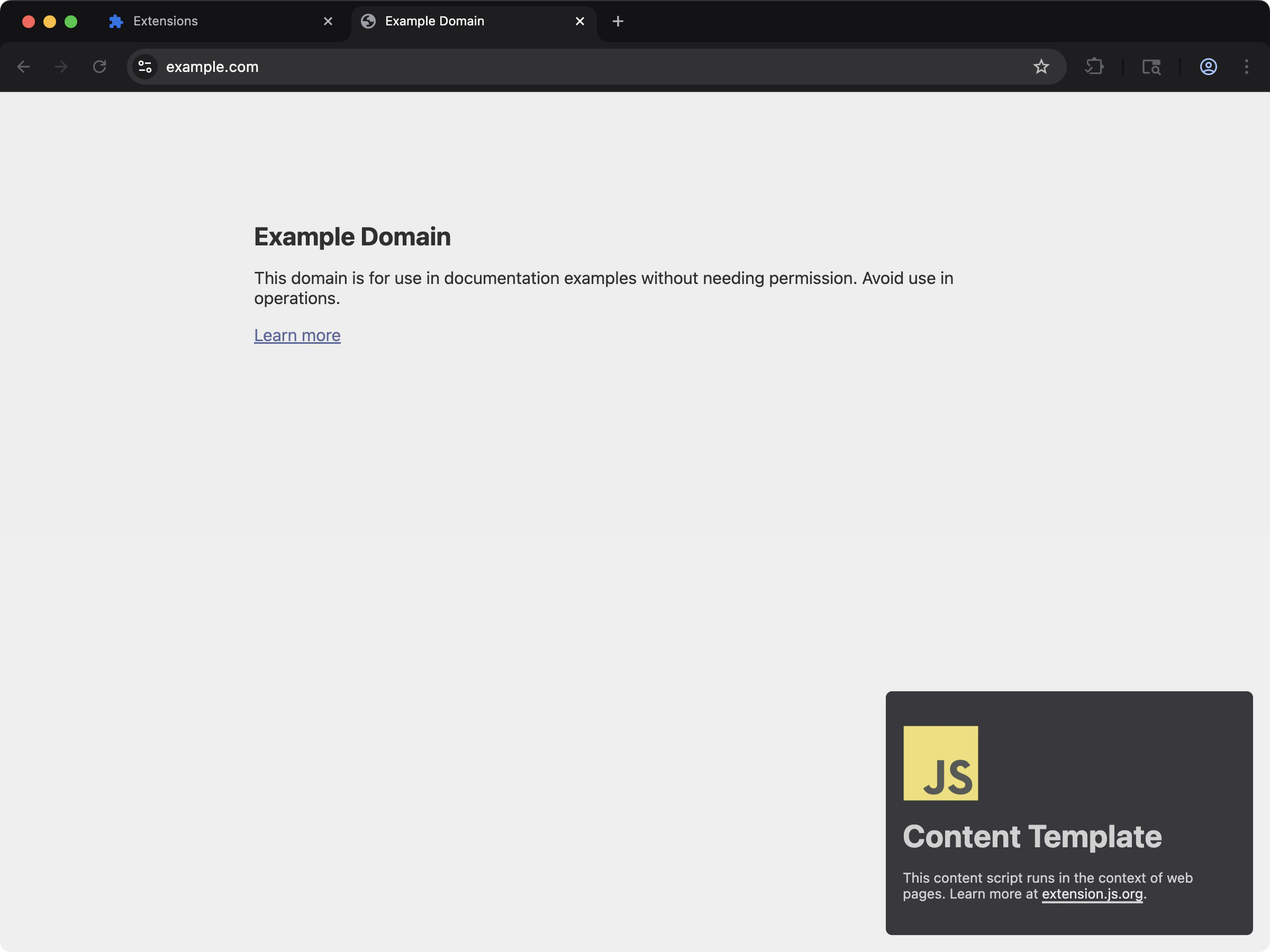
content-react
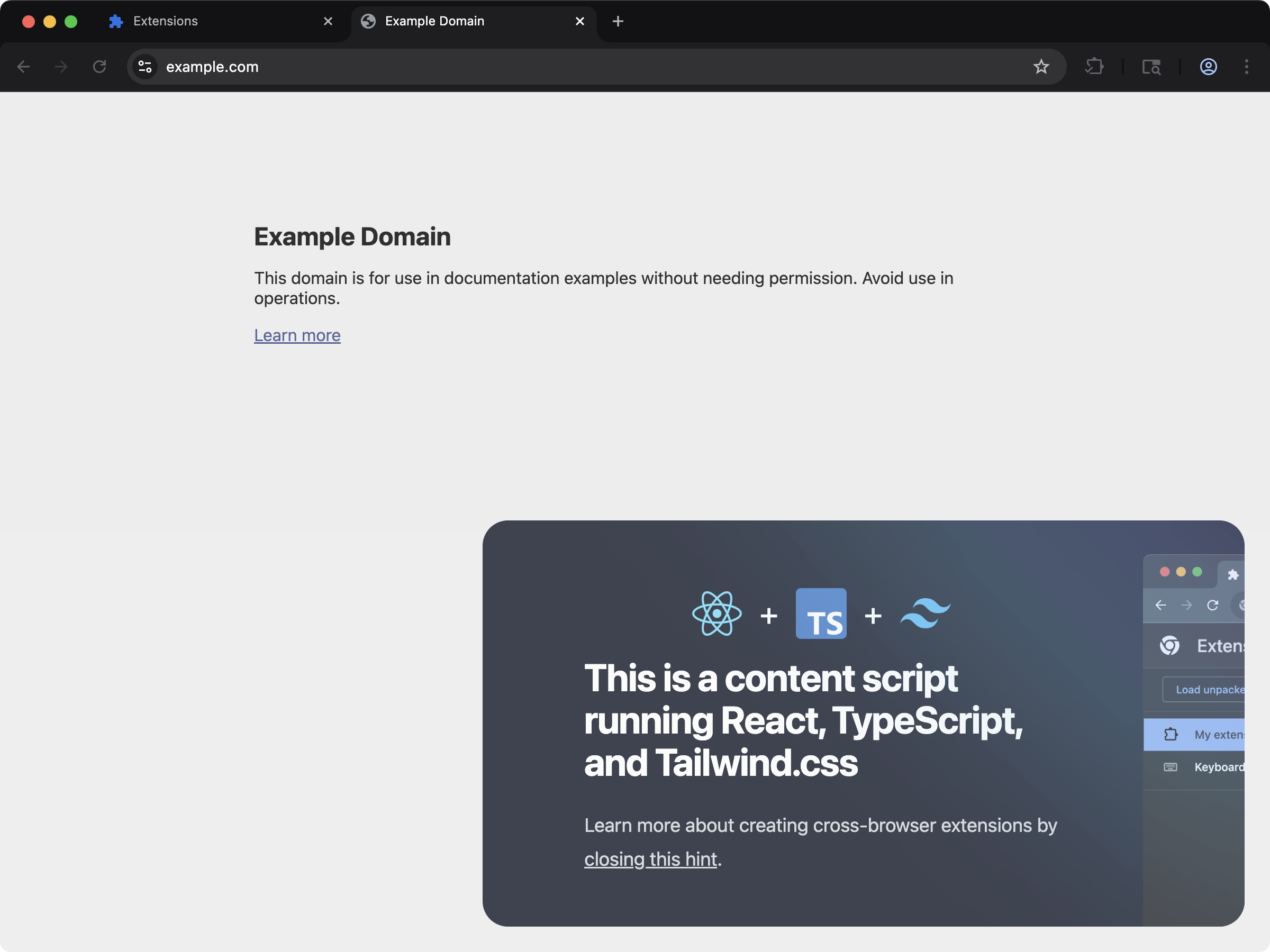
Supported manifest fields
Sample content script declaration
Example content script declaration inmanifest.json:
Authoring contract
For every content-script-like entry, Extension.js expects a mount-style default export. This is a function that sets up behavior and optionally returns a cleanup callback:- The module should
export defaulta synchronous function. - That function should perform setup work.
- It may return a synchronous cleanup callback.
- Extension.js does not support classes as the default export.
- Files referenced by
manifest.json > content_scripts[*].js. - Files you place under the project
scripts/folder and use as script entrypoints.
Valid shapes
Invalid shapes
Guidance for async content scripts
Keep the default export synchronous even when the feature does async work internally. Start async work inside the function and return a synchronous cleanup. Why this matters: Extension.js remounts content scripts during development. Without a cleanup function, you can duplicate UI, event listeners, observers, and timers.What happens on contract violations
- No default export: the module runs when it loads, as written, and Extension.js has no cleanup to call. Each re-inject during development adds another running copy. The dev session prints a warning that names the file, once per entry. This hint needs 4.1.39 or later.
- Default export is not a function: Extension.js warns during development and skips mounting.
- Default export returns a Promise: the module still runs, but Extension.js does not treat that
Promiseas cleanup.
What survives a whole-extension reload
When an edit inextension dev reloads the whole extension, a tab that stays open still holds the copy of your content script from before the reload. What happens to that old copy depends on the browser engine:
- Chromium keeps the old copy running in the open tab beside the new one until the tab reloads, timers and listeners included. Its
chrome.runtime.idis gone, and no cleanup is called for it, even when the script has a default export that returns one. - Firefox discards the old copy. No cleanup is called for it, and it never runs again.
chrome.runtime.id is gone:
data-extension-root. When the next copy starts, Extension.js removes the hosts that an older copy left behind, on Chromium and on Firefox:
Runtime wrapper behavior
- Extension.js wraps content script modules with mount/runtime helpers.
- The wrapper also applies in production builds, and no option turns it off.
- From the release after 4.1.41, the wrapper runs after your own loaders. See Loader order.
- In development mode, Extension.js adds HMR accept/dispose behavior and remount flow.
- CSS updates trigger remount events (
__EXTENSIONJS_CSS_UPDATE__) in development. - Extension.js respects
run_attiming from manifest values.
Multi-entry content scripts
You can declare multiple content script entries in a single manifest. Each entry compiles independently with its own match patterns, run timing, and world settings.content-multi-one-entry
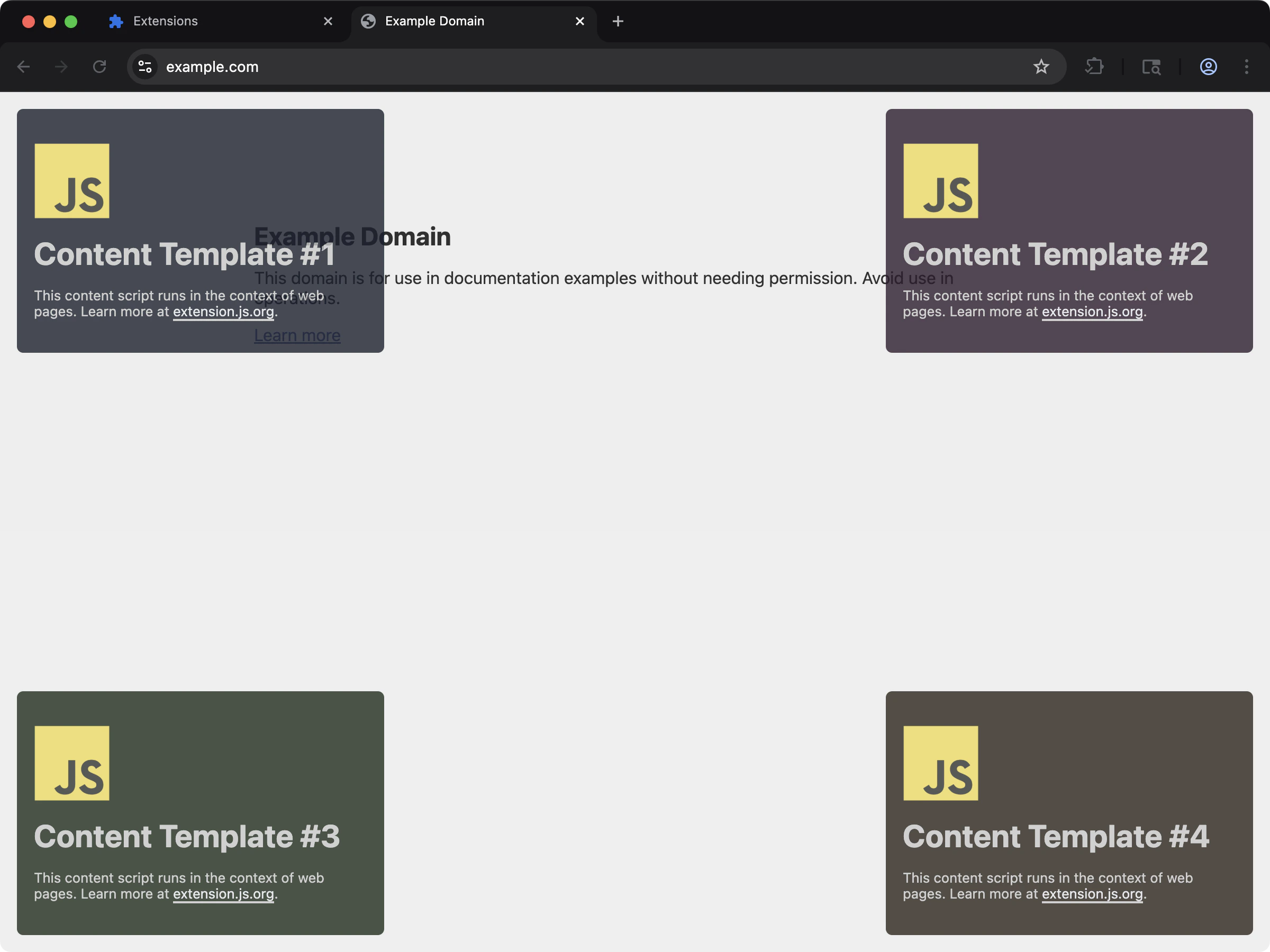
content_scripts manifest entry.
content-multi-three-entries
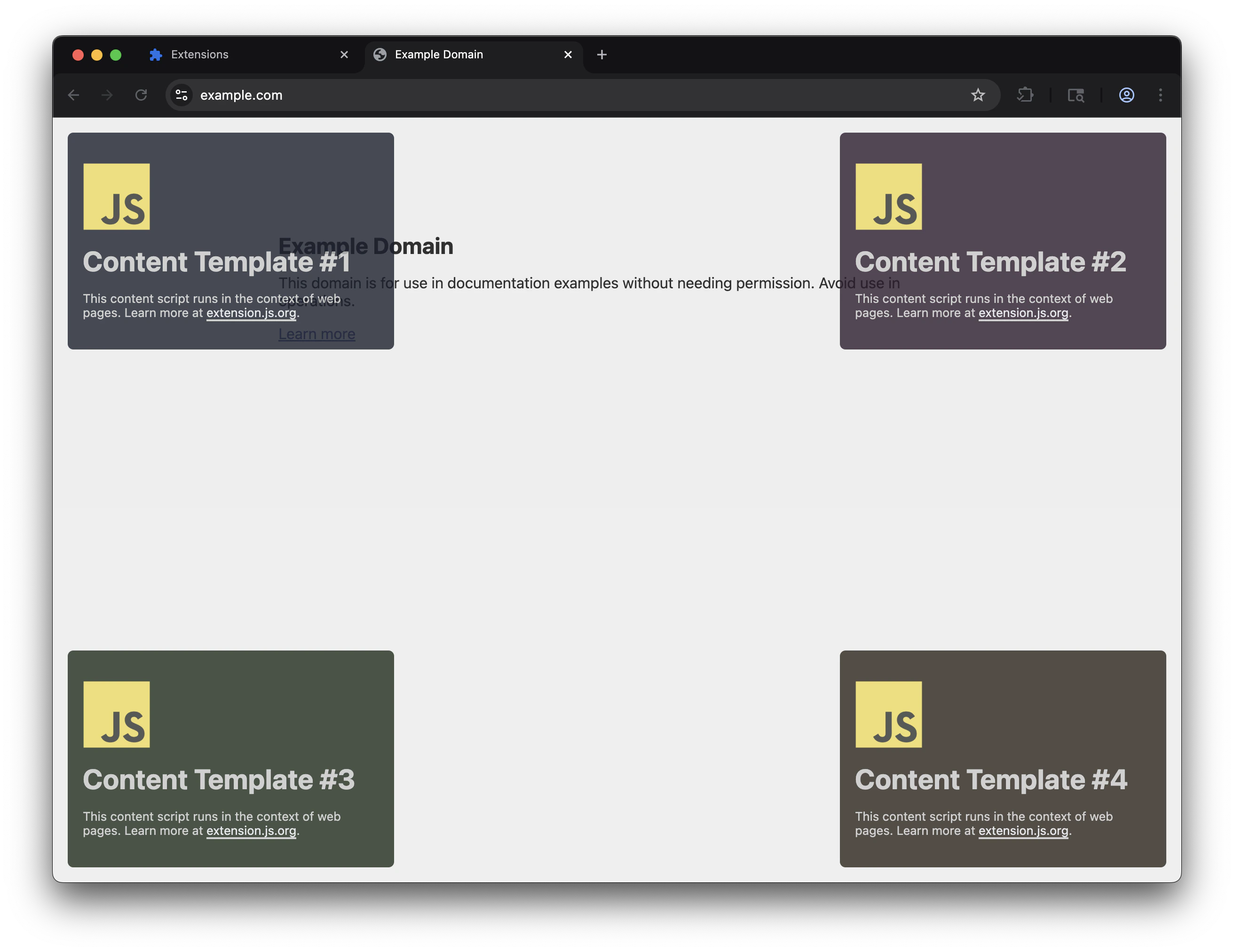
content_scripts manifest entries with independent match patterns.
Classic multi-file entries
When onecontent_scripts.js array lists several plain JavaScript files with no import or export, Extension.js concatenates them into one bundle. Bundling each file as an isolated module would break them. The browser injects classic files in order into one shared scope, and concatenation preserves that:
- Implicit cross-file globals keep working. A top-level
varor function in the first file stays visible to the next file. - Each source file registers as a build dependency, so saving any file in the group triggers a rebuild.
- The emitted source map points at your real files and lines, so errors trace back to the original code.
- A raw
.tsfile inside a concat group gets its types stripped with the bundled SWC before concatenation.
import or export keep normal module bundling.
scripts/ folder behavior
The scripts/ folder is for script entrypoints that no HTML page entry declares. In practice, these entries follow the same default-export pattern as content scripts.
That means scripts/ is not a generic folder for loose JavaScript files:
- Script entry files should still export a default function when they mount behavior
- Extension.js treats adding or removing supported files under
scripts/as a structural change in watch mode - When a manifest edit adds, removes, or renames a script entry, a running
extension devsession restarts its compiler and reloads the extension. You do not restart the command. From the release after 4.1.41, the session also restarts when a script moves to another manifest key, such as the same file moved frombackground.scriptstobackground.service_worker.
Output path
Extension.js normalizes content script entries per manifest index:content-0.abcd1234.js). This forces the browser to load a fresh chrome-extension:// URL after each rebuild.
Chrome aggressively caches extension resources, so the hash prevents stale code. Production builds use clean content-0.js names.
MAIN world notes
content-main-world
See MAIN world content scripts in action with a working example that injects UI directly into the page context:
world: "MAIN"works on Chrome 111, Firefox 128, and Safari 18 or later. The script runs in the page’s own JavaScript world on all three. On Firefox, that holds under Manifest V2 and Manifest V3.- A MAIN world script has no extension APIs.
chrome.runtime,chrome.storage, and the rest are not available there, and you can only access page-context globals. Pair it with an isolated-world script to talk to the extension. - A browser prefix is only worth it for older browsers. Use
chromium:worldwith an isolated-world fallback only if you must support a browser older than those versions. - A
scripts/file can run in the MAIN world too. Register or inject it at runtime withworld: "MAIN". See Inject scripts at runtime. - From 4.2.0, a MAIN world script that fails to compile ships no broken bundle.
- Treat MAIN world as an advanced path. Validate behavior on each target browser early.
The isolated-world bridge
MAIN world scripts cannot call extension APIs, so Extension.js pairs each MAIN group with a helper that can. Expect the built manifest to differ from your source here:- The dist manifest contains more
content_scriptsentries than the source. Extension.js prepends one isolated-world bridge entry before each MAIN group. - Bridge entries take asset indices after your entries. Your
content_scripts/content-Noutputs keep the index of the source entry that produced them. - The bridge resolves extension URLs through
runtime.getURLand injects the MAIN world’s script chunks into the page. From the release after 4.1.39, it injects nothing on Firefox, and the MAIN world script loads its own chunks. - The bridge validates that
event.sourceis the same window before acting on a message. - It injects only extension-scheme URLs (
chrome-extension://,moz-extension://) or relative paths, never arbitrary remote URLs.
Extension URLs that the page can read on Firefox
On Firefox, yourmoz-extension:// origin carries an id that is unique to each install. A page that learns it can recognize the same browser again.
From the release after 4.1.39, the build hands a MAIN world script that origin without writing it into the page’s DOM. The page cannot read the origin from that hand-off.
That covers the build’s own plumbing only. The page can read anything that your script places in the DOM:
- An
<img src>or a<link href>that points at an extension asset. - A
fetchof an extension URL, when the page has patchedfetch. - A component
<style>block whoseurl()names an extension asset. The sheet lands in a<style>element in the document.
Isolated vs MAIN quick example
MAIN only when you need page-context access, and account for extension API/runtime constraints.
Support older browsers with a prefix
On Chrome 111, Firefox 128, and Safari 18 or later, the plainworld key in the quick example is all that you need. A Firefox version older than 128 ignores the world key and runs the script in the isolated world. If you must support one, use browser-specific prefixes to declare MAIN world only for Chromium and provide an isolated fallback for Firefox. Every Firefox version then runs the fallback, including the versions that support MAIN:
chromium: prefixed fields entirely, so the second entry reaches the Firefox build with no js and no css. Firefox gets nothing from it. The build leaves that entry out of the Firefox manifest and prints why:
js on the same entry. A prefixed key overrides the plain key with the same name, so Chromium still takes chromium:js in the MAIN world and Firefox runs the plain js in the isolated world. One entry then covers both browsers, and the build prints no warning:
js is the base every target reads, so the entry stays whole on any browser that does not resolve chromium:. firefox:js also keeps the entry, but only on Gecko targets, and the prefix page’s rule is to write the plain key as the base and prefix only the exception.
Matching and execution guidance
The browser still controls where a content script runs. Extension.js bundles the file, but the manifest entry still defines where and when the script runs.- Keep
matchesas narrow as the feature allows. - Add
exclude_matches,all_frames, ormatch_about_blankonly when the feature actually requires those behaviors. - Treat
run_atandworldas part of the feature contract, not an implementation detail. - Re-test permission and host-permission scope when changing where a content script runs.
Development behavior
- Editing content script code usually updates through wrapper-driven HMR/remount flow.
- CSS-only entries receive dev helper behavior so style updates can propagate.
- When a manifest edit adds, removes, or renames a script entry, a running
extension devsession restarts its compiler and reloads the extension. You do not restart the command. From the release after 4.1.41, the session also restarts when a script moves to another manifest key, such as the same file moved frombackground.scriptstobackground.service_worker.
Best practices
- Keep content script entry files small and delegate logic to shared modules.
- Scope selectors/styles carefully to avoid host-page collisions.
- Prefer explicit
run_atandworldvalues when behavior depends on timing/context. - Treat manifest content-script list changes as structural development changes.
- Pass page-derived data through validated messaging instead of performing privileged work directly in the content script.
- Default to isolated world and move to
MAINonly when the page context is strictly required.
Next steps
- Understand update outcomes in dev update behavior.
- Design cross-context communication with Messaging.
- Review access scope in Permissions and host permissions.
- Learn about web-accessible resources.
- Continue with locales in development.